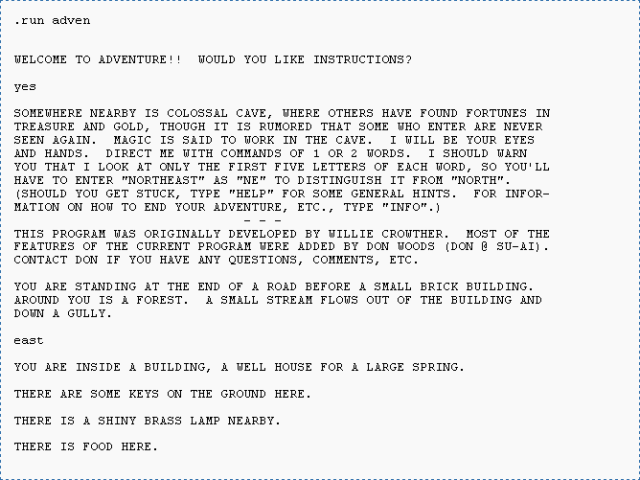
- I guess nowadays nobody would want to play e. g. King's Quest and what not, but in the 1980s or so that was novel and creative. Today the games tend to have powerful 3D engines, but the creativity was lost for the most part. Sometimes there is still innovation (Little Nightmares brought something new to the table, for instance) and of course the graphics and sounds are great, but something is gone now. In part this may be me getting older, but in part I also think that the whole computer game segment got much more boring over time.
- I fondly remember playing games typed out from books and magazines when I was younger - although I usually tricked my little brother into typing out the game so we could both play it.
Jokes on me though, since now he can type at over 100 wpm (and uses dvorak)
- For a fascinating insight into "The Colossal Cave Adventure" see the Literate Program version of the source:
- One of my dream games is a truly open world text adventure. I got a glimpse of it by having ChatGPT run this game, but it started hallucinating and misremembering after a few rounds. It has to be perfect to avoid breaking the immersion, but I'd pay $100 for such a game even without graphics.
- I'd just begun my first professional engineering job after college. The company I was working for had a mainframe computer on which there was a copy of Adventure. When I discovered the game, there were a number of late nights playing it. One night, long after everyone had gone home, I was playing in my office with the lights off. The only light was from the green phosphorous monitor I was using. All of a sudden, I stumbled into the breath-taking view room with its erupting volcano. The words describing the scene filled the screen with descriptive prose that simply glowed in the dark room. The effect was mesmerizing. Forty-seven years later, I've never forgotten that.
- Interesting.
I recently investigated text based adventure games in Python as a possible tool to teach and evaluate outdoor wilderness safety knowledge and awareness (backpacking and overnight camping) for wilderness therapy.
While doing the research I recalled a friend showing me a text adventure game on his i386 PC. I could not understand the appeal. The possibilities the game suggested were vast, but the effective actions were unattainable--I was not able to see even the most basic level of progress before I became bored.
Now, outlining the wilderness safety "game", its obvious to me some understanding of software and programming would have made the game accessible. Then maybe a key in a room would be better understood as a metaphor of the code. In other words, a game at text level can be an attempt to model a complicated problem in an interactive program. If you can write a game where the final product is convincing (suspend disbelief), then maybe the game's model can be useful for other things. In my case instruction and evaluation of basic domain knowledge. And this level of programming awareness is useful in not getting bored (or experiencing cognitive gap between what a text implies and what the game can deliver).
- There was a Hitchhiker's Guide to the Galaxy text adventure, with writing from Douglas Adams. It's entertaining, but insane what you have to figure out to get the babel fish...
https://en.wikipedia.org/wiki/The_Hitchhiker%27s_Guide_to_th...
- > Play was central to the formation of personal computer culture.
In his book, Wonderland: How Play Made the Modern World, Steven Johnson applies this thesis to pretty much all the things. Enjoyable book, but the thesis probably does not hold up too much scrutiny.
- Something about the modern day fails to match the feelings of when MUDs were in their prime. With text you can describe so much more than a picture can paint. You can visualize a smell, a taste, or a feeling in text, but it doesn't translate well when you have graphics painting your imagination for you.
- For Spanish speakers there, there's "Aventura.z5" at IFDB, you can play it with a Frotz interpreter. It's 99% close to the original modulo some odd wordplay. The backstory and all it's the same, with the Mammoth Cave descriptions with the slaves and the like.
- Text adventures whilst sometimes infuriating, if played as they are meant to be back when released with a piece of graph paper to help map out where you have been and where you go, there is still some magic about them that isn't had with graphical games. Every room becomes exciting which just isn't the case even in my favourite games such as Fallout New Vegas. Oh more bottle caps again in a drawer but I can begin to tell what rooms will be essential to look in and which won't buy the middle of the game. There is none of that in text games, you just have to explore and get truly lost, another thing that is much harder to do nowadays.
- Some fantastic text adventures can still be had online. There are MUDs (my favorite), Roguelikes, Sims, and even cyberpunk adventures. A half dozen Star Wars ones as well.
This was peak 1986. A few years later and we’d be jumping a little pixel plumber on cathode ray tubes.
Can’t wait for the next part…
- I wonder how a book of type-in AI prompts would do…
- I loved this game. I want to make it into a mud.
- I think the most annoying thing of a lot of modern games is the whole crafting thing that is bolted onto everything. But there are some real gems out there for old school gamers. I loved Baldurs Gate 3, Divinity 2, Expedition 33 and Disco Elysium for example as really fun and interesting CRPG's. It's just that the cost of taking a risk these days is to high for studios and most kids are playing "free" games for most of their time. So even though the market is big it feels like the "growth" is mostly in the "free" games part of the market which is terrible.