- Mary Lou Jepsen of openwater.cc [2] has managed to image neurons and other large cell structures deep inside living bodies by phase wave interferometry and descattering signals through human tissues, even through skull and bone[1] using CMOS imageing chips, lasers, ultrasonics and holographics. A thousand times cheaper fMRI. She aims to get to realtime million pixels moving picture resolutions of around a micron. Eventually she will be able to read and write neurons or vibrate and someday maybe burn cell tissues to destruction.
There are later presentations at the website where the technique is better described and visualized, but [1] is a good quick place to start and judge if you want to study their brainscanner in more depth. There are patents and a few scientific publications [3] that I'm aware of, but mostly many up to date talks with demonstrations by startup founder Mary Lou [4]. And recently she is open sourcing[5] parts of the hardware and software on github [6] so we can start building our own lab setups and improve the imageing software.
[1] https://www.youtube.com/watch?v=awADEuv5vWY
[2] https://www.openwater.health/
[3] https://scholar.google.com/citations?hl=en&user=5Ni7umEAAAAJ...
[4] https://www.youtube.com/watch?v=U_cHAH4T8Co
- Interesting, but probably not cheap:
> This is achieved by having more than 0.5 megawatts peak power
and
> The input peak power up to 1.60 MW (350-nJ pulse energy)
https://www.science.org/doi/10.1126/sciadv.adp2438
I wonder how much it affects/fries the tissue. HHG also has issues with attenuation.
The paper abstract also says previous state of the art was 300um not 200um like in the press release.
- 300 to 700 micrometers? So almost nothing to still almost nothing.
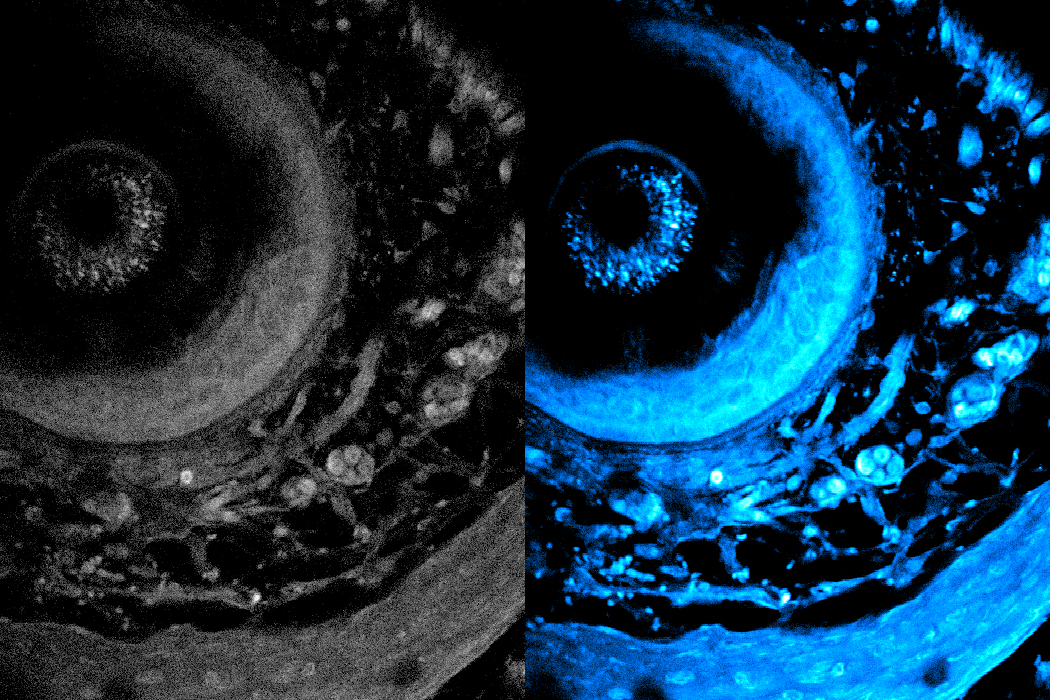
Could anyone tell a difference in the before and after images, other than one was grey and the other was blue? Structurally, they looked identical to me.
Edit: internet tells me human cells are around 25um, so I guess you can tens of cells deep
- >excitation of NAD(P)H at 1100 nm.
Better to understand this in context of the general techniques like this:
http://en.wikipedia.org/wiki/Near-infrared_window_in_biologi...
- What about NIR spectroscopy? It penetrates the bio window at >1200 microns now…not sure how this compares? I mean signal processing wise, I would assume NIR does the trick.
deleted
- A better title and subtitle is needed though... "Noninvasive" and "Using high-powered lasers" might sound a little bit an oxymoron...
deleted
- Hmm that before/after photo looks like they spent about 5 minutes in Photoshop tweaking the curves. Is it really meant to demonstrate an improvement?